Bean-to-Cup vs Espresso Machine: Which Suits Your Needs?

It comes up in almost every conversation we have with office managers and facilities teams across Ireland. They know they want proper coffee in the workplace. They know the old kettle and instant setup isn’t cutting it anymore. But when they start looking at options, they hit the same fork in the road.

Bean-to-cup or espresso machine?

Both produce excellent coffee. Both grind fresh beans. Both can serve up the lattes, cappuccinos, and americanos that have become standard expectations in any decent workplace. On the surface, they seem like two routes to the same destination.

They’re not. And for businesses, the differences matter far more than they do for someone kitting out their kitchen at home.

An espresso machine in a cafe makes perfect sense. A skilled barista stands behind it all day, pulling shots, steaming milk, adjusting grind settings on the fly. The machine is a tool in trained hands. That’s how it’s designed to work.

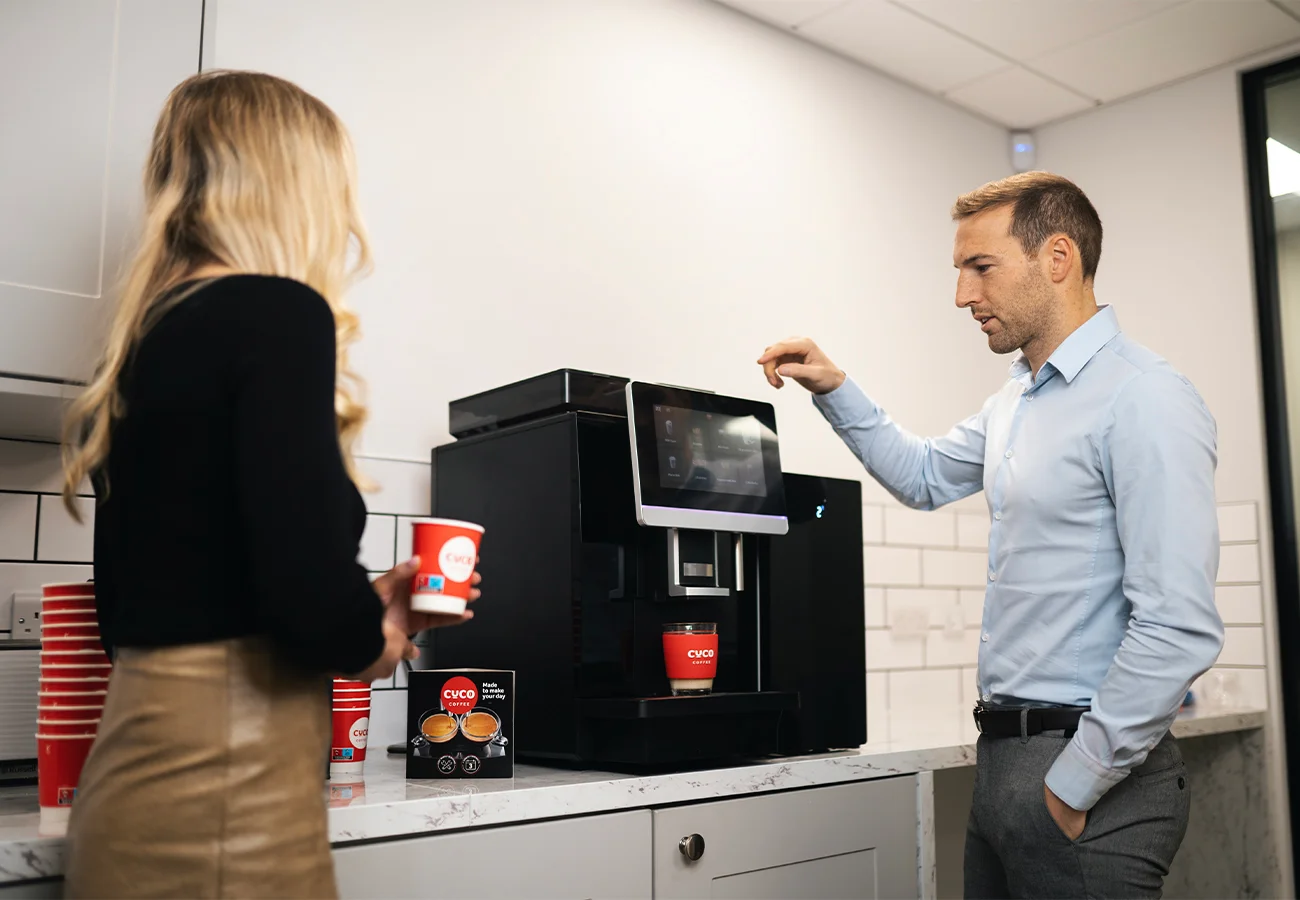
An office environment is nothing like a cafe. Nobody is employed to make coffee. People wander over between meetings, want something decent in under a minute, and get back to their desks. The machine has to work for everyone, from the graduate who joined last Monday to the managing director who likes a flat white at precisely eleven o’clock.

This guide compares bean-to-cup and espresso machines through a business lens. Not which makes the “best” coffee in some abstract sense, but which delivers the best outcome for a working environment. We’ll look at staffing, coffee quality, maintenance, costs, and the practical realities that rarely make it into product brochures.

If you’re weighing up this decision for your office, this should save you a few headaches.
First Things First: What Does Bean-to-Cup Actually Mean?

If you’re seeing the term for the first time, it’s worth a quick explanation before we get into comparisons.

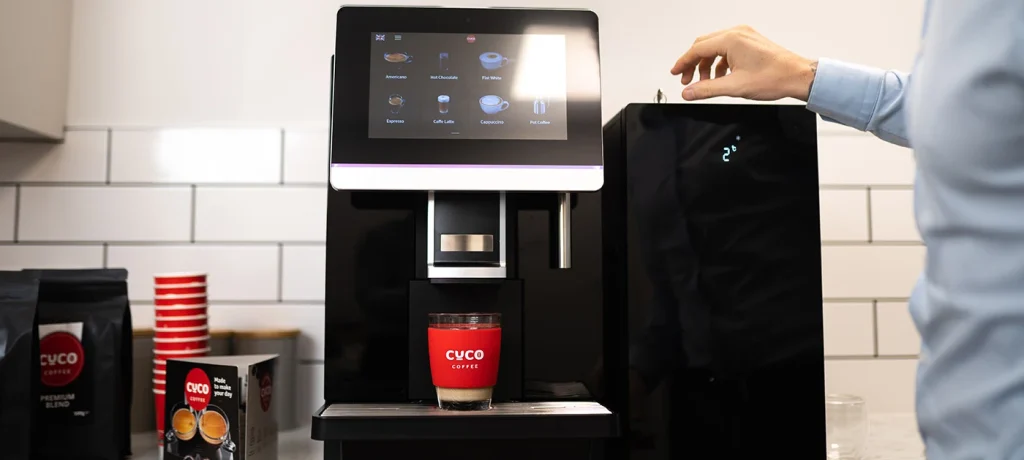
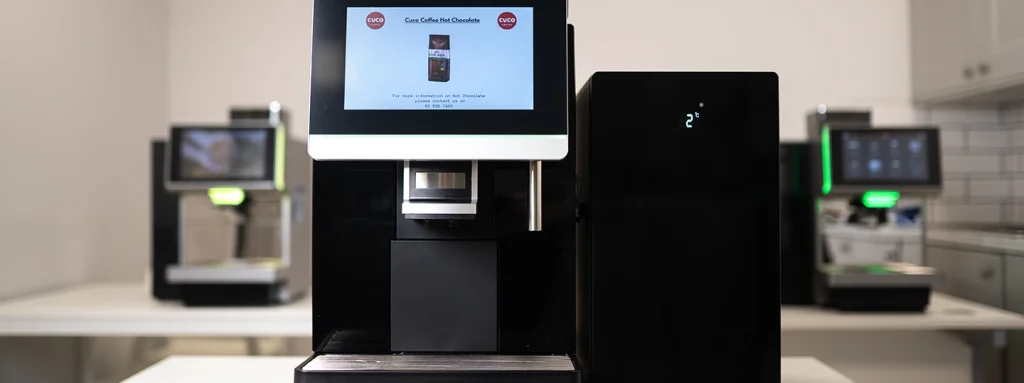
A bean-to-cup coffee machine is a fully automatic machine that handles the entire process of making coffee from whole beans. You load beans into a hopper at the top, press a button, and the machine grinds, tamps, brews, and dispenses a finished drink. Some models froth milk automatically too. The name is literal: it takes you from bean to cup with no steps in between.

An espresso machine is what you see in coffee shops. The barista grinds the beans separately, doses them into a portafilter, tamps them by hand, locks the portafilter into the machine, and starts the extraction. Milk is steamed manually with a steam wand. Every step depends on the person behind the machine.

There are also semi-automatic espresso machines that automate the water flow but still require manual grinding, dosing, and tamping. Even these need someone who understands what they’re doing.

So when people ask “bean-to-cup or espresso?”, what they’re really asking is: automatic or manual? And in a workplace, that question has a very clear answer for most businesses. But let’s work through the detail properly.

How Bean-to-Cup and Espresso Machines Actually Differ

Before getting into the business specifics, it helps to understand what separates these two machine types at a technical level.

Bean-to-cup machines are fully automatic. Whole beans sit in a hopper at the top. When someone selects a drink, the machine grinds the exact amount needed, tamps it, forces hot water through at the right pressure, froths milk if required, and delivers the finished drink into the cup. The entire process happens behind the panels. Press a button, wait roughly 40 to 60 seconds, and take your coffee.

Espresso machines (sometimes called traditional or manual machines) are the type you see in coffee shops. A person grinds the beans separately, doses them into a portafilter, tamps them by hand, locks the portafilter into the machine, and starts the extraction. Milk is steamed manually using a steam wand. Every step requires a decision and a degree of skill.

There are semi-automatic espresso machines that handle some steps, but even these need someone who understands what they’re doing. The extraction time, grind size, and milk texturing all depend on the operator.

The fundamental difference comes down to this: bean-to-cup machines remove human skill from the equation. Espresso machines rely on it.

In a cafe, that human element is an asset. In an office, it’s usually a liability. But there’s more to it than that, and it’s worth working through each factor properly.

Pros and Cons of Espresso Machines

Pros

  • Authentic coffee flavor and aroma
  • Complete control over the brewing process
  • Very easy to use
  • Available in many sleek and stylish designs

Cons

  • Can only make an espresso
  • Steep learning curve for mastering the technique
  • Requires more hands-on effort
  • Bean-to-Cup vs Espresso Machine: What is the best option?

Who Needs to Operate the Machine?

This is where the conversation gets real for businesses, and it’s the factor that tends to settle the debate more often than anything else.

An espresso machine needs an operator who knows what they’re doing. Not a qualified barista, necessarily, but someone who has been trained and practices regularly enough to maintain quality. That means learning how to dial in the grinder each morning (because beans change with age, humidity, and temperature). It means understanding extraction times, knowing when the shot looks right, and developing the muscle memory for consistent milk frothing.

In a cafe, this is the barista’s entire job. In an office, who takes on that role?

Some businesses try designating a coffee champion. A staff member who gets trained up and takes responsibility for the machine. It works on paper. In practice, it falls apart quickly. That person goes on annual leave. They get promoted and move desks. They leave the company. Suddenly nobody knows how to adjust the grinder, the coffee tastes dreadful, and the machine becomes an expensive ornament.

The other option is training multiple people. But training four or five staff members to use an espresso machine properly takes time, and consistency drops when different people with different skill levels are operating the same equipment. Nobody was hired to make coffee. They have actual jobs to do.

Commercial bean-to-cup machines bypass this entirely. They are designed so that anyone can use them. The touchscreen displays drink options with clear icons. You press what you want. The machine handles everything else. No training beyond “this is where the cups go.” A new starter on their first day can make coffee that tastes identical to what the CEO made that morning. 

That’s not a small thing. In an office of thirty people with regular turnover, the self-serve simplicity of a bean-to-cup machine means the coffee quality never depends on any single person. The machine is the barista. It doesn’t take holidays, it doesn’t call in sick, and it doesn’t need a three-day training course.

For businesses that don’t have dedicated kitchen or canteen staff, this is usually the deciding factor. The coffee might not quite reach the ceiling that a talented barista hits on the espresso machine, but it removes a dependency on one person’s skills that most offices simply can’t sustain.

Does an Espresso Machine Make Better Coffee?

This is the question people really want answered. And the honest answer is: it depends on who’s making it.

At its best, an espresso machine in skilled hands will produce coffee that outperforms a bean-to-cup machine. The ability to adjust every variable, from grind particle size to extraction time to milk temperature, means a good barista can coax extraordinary results from quality beans.

But “at its best” is doing a lot of heavy lifting in that sentence.

A bean-to-cup machine produces very good coffee, consistently, every single time. It might not hit the highest highs of a perfectly pulled espresso shot, but it never hits the lows either. There are no burned shots from someone rushing. No weak, under-extracted coffee because the grind was wrong. No lukewarm milk because someone didn’t purge the steam wand properly.

In a workplace, consistency matters more than occasional brilliance. If the marketing team’s morning coffee is excellent on Monday and undrinkable on Tuesday because a different person made it, that inconsistency becomes a problem. People lose confidence in the machine. They start going to the cafe down the road. The company’s investment in workplace coffee stops delivering returns.

Modern bean-to-cup machines have closed much of the quality gap. The machines we see installed across Irish offices produce genuinely impressive coffee. The espresso has proper crema. The milk is textured well. The flat whites are silky. Most people cannot reliably tell the difference in a blind tasting between a good bean-to-cup flat white and one made by a competent barista.

Where espresso machines still hold an edge is in the very top tier of specialty coffee preparation. Pour-overs, manual brew methods, competition-level espresso. None of which are relevant to someone who just wants a decent coffee before their ten o’clock meeting.

For office use, bean-to-cup machines deliver the quality that matters: reliably excellent coffee, every cup, for every person. And when you pair that with freshly roasted beans and a well-maintained office coffee machine, the results genuinely surprise people who assumed “automatic” meant “compromise.”

Keeping Up With Demand: Volume and Speed Compared

Morning rush. The fifteen minutes between nine and quarter past when half the office decides they need caffeine at exactly the same time.

How each machine type handles this tells you a lot about its suitability for business use.

A bean-to-cup machine produces drinks sequentially. One cup at a time, roughly 40 to 60 seconds each. During peak times, there might be a short queue. But the machine works through it steadily, and everyone gets the same quality coffee regardless of how busy it is.

An espresso machine can theoretically produce drinks faster in skilled hands. An experienced barista can extract a shot while simultaneously steaming milk for the previous order, managing two or three drinks in overlapping stages. But this requires that skilled operator to be present and focused. Without one, the queue at an espresso machine actually moves slower, because untrained users take longer and make more mistakes.

Factor

Bean-to-Cup

Expresso Machine

Drinks/hour (self-serve)


40 to 60

10 to 20


Drinks/hour (trained operator)

40 to 60

50 to 80

Wait time per drink

40 to 60 seconds


2 to 5 minutes (self-serve)

Consistency under pressure

Identical quality


Declines without skilled operator

The numbers tell a clear story for self-serve environments. Without a trained operator, an espresso machine’s throughput drops dramatically while quality suffers. A bean-to-cup machine just keeps doing its thing, cup after cup, at the same pace and the same standard.

Bean-to-cup machines also scale predictably. If your office grows or demand increases, you add another machine. The output stays consistent regardless. Espresso machines scale with people, and good people are harder to find than good machines.  

Maintenance and Cleaning: What Each Machine Demands

Both machine types need regular maintenance. But the effort involved is noticeably different, and in an office where nobody’s job description includes “look after the coffee machine,” this matters more than people expect.

Espresso Machine Daily Maintenance

An espresso machine needs hands-on attention every day. The group heads must be backflushed, which involves running cleaning solution through the brewing mechanism to remove coffee oil buildup. The steam wand needs purging and wiping after every use (and a proper deep clean at the end of each day). Portafilters should be rinsed and the baskets scrubbed. Drip trays emptied. Grinder hoppers checked and the dosing chamber cleared.

Skip a day of backflushing and you’ll taste it in the coffee. Skip a week of steam wand cleaning and you’ll smell it. These aren’t optional tasks. They’re essential for both hygiene and coffee quality.

The problem in an office environment is obvious. Who does this? It has to happen every single day, and it has to be done properly. If nobody takes ownership, the machine deteriorates fast.

Bean-to-Cup Daily Maintenance

Most bean-to-cup machines handle the bulk of their own cleaning. Milk systems self-rinse after each use. An automatic cleaning cycle runs at the touch of a button (or on a timer) at the end of each day. The main manual tasks are emptying the drip tray, clearing the used grounds container, and wiping external surfaces.

It takes five minutes compared to fifteen or twenty for an espresso machine. And if someone forgets one day, the machine doesn’t punish you the way an espresso machine does.

Weekly and Professional Maintenance

Both machines benefit from weekly deep cleaning and periodic professional servicing. Descaling, grinder calibration, seal replacement, pressure testing.

The difference is in what happens between professional visits. An espresso machine that isn’t cleaned properly by its daily users deteriorates quickly. Coffee residue builds up in the group head. Milk scalds onto the steam wand. Grinder burrs clog with oils. By the time a service technician arrives, they’re dealing with problems that shouldn’t have developed.

Bean-to-cup machines are more forgiving. The automated cleaning systems mean that even if staff aren’t particularly diligent, the machine stays in reasonable condition between service visits. And when your supplier includes regular professional servicing as part of the arrangement, the entire coffee operation essentially runs itself. 

Hygiene in Shared Environments

In a workplace where dozens of people use the same equipment, hygiene matters. Bean-to-cup machines have a clear advantage here. The milk system is enclosed and self-cleaning. Users don’t touch anything that contacts food or drink. There are no portafilters sitting in knock boxes between uses.

Espresso machines, by their nature, involve more handling. Portafilters get left on counters. Steam wands get splashed with milk that isn’t wiped off. Ground coffee scatters around the workspace. In an office without someone dedicated to keeping things tidy, this becomes a problem quickly.

Space Requirements and Installation

Office space is expensive. The footprint of your coffee setup matters.

A bean-to-cup machine is a self-contained unit. Everything sits within one housing: the grinder, the brewer, the milk system. A typical mid-range commercial bean-to-cup measures roughly 350mm wide by 550mm deep by 600mm tall. Some models include an integrated milk fridge. Others connect to a small external fridge that tucks underneath. One machine, one spot on the counter, job done.

An espresso machine needs more room. The machine itself is wider, typically 500mm to 700mm. Then you need space alongside it for the grinder, a knock box, a tamping station, and room to work with milk jugs. A practical espresso setup usually occupies 800mm to 1,200mm of counter width. That’s nearly the full length of a standard office kitchenette counter.

Both machine types ideally connect to mains water, though smaller bean-to-cup machines can work from a refillable tank for lighter use. Both need a standard electrical connection, though espresso machines with large boilers may draw more power.

For most Irish offices, where the coffee machine shares a kitchenette with a microwave, a kettle, and a sink, the compact footprint of a bean-to-cup machine is a significant practical advantage. You get a complete coffee solution without having to redesign the kitchen.

What About Cost?

Bean-to-cup machines generally have a higher price tag since they come with an integrated grinder. Plus, the brewing process is fully automated, and users have access to a more diverse range of beverage options. These machines essentially combine the features of a separate grinder and espresso machine into one unit, which is why they tend to cost more.

On the other hand, espresso machines can vary in cost based on their type and features. Basic manual models are pretty affordable, but they only brew one espresso at a time. High-end commercial espresso machines can be expensive, but they come with advanced features and multiple group heads.

Plus, remember that if you choose an espresso machine, you’ll also need to factor in the cost of a separate grinder. So, the price difference between a bean-to-cup and espresso machine isn’t that steep if you think about it.

So Which Is Better for Your Business?

There’s no universal answer, but for most Irish offices, the choice is clear.

Choose an espresso machine if:

  • You have dedicated canteen or kitchen staff who can be trained and who will be present during working hours.
  • You’re in a hospitality or client-facing setting where the theatre of hand-crafted coffee adds genuine value.
  • Coffee quality at the absolute highest level is a real business priority, and you’re prepared to staff for it.
  • You have the counter space for a full setup including grinder and accessories.

Choose a bean-to-cup machine if:

  • Your office is self-serve, where people make their own drinks.
  • You don’t have (and don’t want to employ) someone to operate the machine.
  • Consistency matters. You need the coffee to be excellent every time, regardless of who’s making it.
  • You want minimal daily maintenance burden on your staff.
  • Space is tight and you need a compact solution.
  • You’d rather the machine handled the skill so your team can focus on their actual work.

For the vast majority of offices, workplaces, showrooms, and shared spaces across Ireland, commercial bean-to-cup machines deliver the better overall outcome. They require less management, produce consistently good coffee, take up less space, and work for every single person in the building from day one. Paired with a good rental arrangement that includes regular servicing, the entire coffee operation essentially runs itself. 

The espresso machine romantic in you might resist that conclusion. But romanticism doesn’t survive contact with a Monday morning office queue.

Ready to See the Difference?

If you’re leaning toward bean-to-cup for your workplace, the next step is simple. Try before you commit.

We offer a free coffee tasting in your office, using your water supply, so you can see exactly what the coffee tastes like in your environment. No obligation. No hard sell. Just a chance to let your team try it and decide for themselves.

Explore our range of commercial bean-to-cup machines, check out our flexible rental options, or get in touch to arrange a tasting.

Your office deserves better than instant. And it probably doesn’t need a barista to get there.

Frequently Asked Questions

What is a bean-to-cup coffee machine?

Bean-to-cup coffee machines are automatic coffee makers that streamline the entire brewing process, from grinding whole coffee beans to dispensing a fresh cup of coffee. This machine allows for a quick and simple coffee-making experience since you don’t need to use any separate grinders, tampers, and other equipment.

Is a bean-to-cup machine worth it for an office?

For most offices, yes. The combination of consistent quality, self-serve simplicity, low maintenance, and compact size makes bean-to-cup the practical choice for workplaces where nobody is employed to make coffee. The cost per cup is a fraction of cafe prices, and rental arrangements mean there’s no large upfront investment. Staff get barista-quality coffee without the need for a barista.

Can a bean-to-cup machine make real espresso?

Yes. Modern commercial bean-to-cup machines extract espresso using the same principles as a traditional machine: finely ground coffee, high pressure, and controlled temperature. The resulting shot has proper crema and the depth of flavour you’d expect from a well-made espresso. The process is simply automated rather than manual.

Is coffee from an espresso machine fresher than from a bean-to-cup?

No. Both machine types grind beans immediately before brewing, so freshness is equivalent. The difference is in who controls the process, not in the freshness of the result.

Do espresso machines last longer than bean-to-cup machines?

Traditional espresso machines have simpler internal mechanisms and can be easier to repair, which sometimes gives them a longer lifespan. A well-maintained commercial bean-to-cup machine typically lasts seven to ten years. Espresso machines might push a bit beyond that. The trade-off is that espresso machines often need repairs more frequently when used by untrained operators.

Can bean-to-cup machines handle oat milk and other alternatives?

Most commercial bean-to-cup machines work well with oat, soy, and almond milk alternatives. The milk system draws whatever is in the connected container and froths it. Results vary slightly depending on the alternative milk’s protein content, but modern machines handle the popular options without issues.

What if our office wants both options?

Some businesses install a bean-to-cup machine for daily self-serve use and keep a smaller espresso machine for occasional use or for staff who enjoy the hands-on process. This works well if space and budget allow, though the bean-to-cup machine will handle the vast majority of daily demand.

How noisy is each machine type in an office?

Both produce similar noise levels during grinding, around 65 to 75 decibels for a few seconds. An espresso machine’s steam wand is louder than a bean-to-cup machine’s internal milk system. If noise is a concern in an open-plan office, bean-to-cup machines have a slight edge.

Do we need a water line for either machine?

For offices producing more than about 30 to 40 cups daily, a mains water connection is recommended for both types. Smaller bean-to-cup machines can work from a refillable water tank, which adds flexibility for placement but requires regular refilling.

Which machine type is more environmentally friendly?

Bean-to-cup machines generally produce less waste. There are no pods or capsules. Used grounds can be composted. Milk waste is lower because the machine dispenses precisely what each drink needs. Espresso machines generate more waste through milk overuse and cleaning processes, though neither type is inherently wasteful compared to pod or capsule systems.

More News

April 6, 2026

Walk into any thriving Irish office and you’ll notice something. The kettle and jar of instant coffee…

March 30, 2026

Financial offices are judged on details. People notice how a meeting room feels. They notice whether the…

March 9, 2026

Find Out Why Cuco Coffee Delivers the Best Value for Irish Businesses The Role of Coffee in…

February 27, 2026

Coffee queues don’t usually happen because the machine is “too slow”. They happen because a few small…

Get in touch –
we’d love to help!

Take advantage of our specialist advice and expertise by contacting us today.

Get in touch – we’d love to help!